
FAQs: call for Speedy Refugee Family Reunification
Once a person in Canada has been accepted as a refugee (known as a “Protected Person”), they can apply for permanent residence for themselves and their immediate family members (spouse and children). Family members who are overseas must wait for their permanent residence application to be processed before they can travel to Canada. This takes many years.
Temporary Resident Permits (TRPs) should be issued to family members of refugees so that they live in Canada while they wait for their permanent residence applications to be processed.
How long are families waiting to be reunited?
According to the government, family members overseas are waiting over four years (50 months) from the time their parent or spouse in Canada (the Protected Person) applied for permanent residence (as of December 2025). See processing times.
The times are expected to increase dramatically. A Protected Person applying for permanent residence in December 2025 is told it will take 100 months (more than 8 years) to process their application (if they are in Quebec, it is 106 months). It will take even longer for family members who live overseas.
How many people are affected?
In December 2025, IRCC reports that 141,300 people are waiting for permanent residence as Protected Persons. It is not known how many family members overseas are currently waiting, but in April 2024 there were 42,000.
Why the long processing times?
The number of Protected Persons and family members given permanent residence each year is determined by the target set by the government as part of the immigration levels (20,000 for Protected Persons and their family members in 2026).
The number of refugees accepted has increased in recent years but the target has gone down – as a result each year more people apply than receive permanent residence, and the backlog grows bigger and bigger.
What will be the impact of the government’s special initiative for Protected Persons?
In November 2025, the government announced a welcome initiative to provide permanent residence to 115,000 Protected Persons by the end of 2027. This provides some hope for people who have already been waiting years for family reunification.
However, the initiative is designed for people already in Canada, so the implication for family members overseas is not clear. The current size of the backlog also means that only some people who are waiting will qualify.
The targets thus remain woefully inadequate for the numbers of people applying. 37,000 people had their claims accepted by the IRB in 2025 (January to September), yet the 2026 target is only 20,000.
What are the impacts of prolonged family separation?
Children in particular suffer greatly as a result of the long wait. They may:
- Be living in a situation of conflict or insecurity
- Be displaced from their home and living with precarious or no status
- Have limited access to health care
- Not be able to go to school regularly
- Develop trauma as a result of forcible separation from their parents
Parents in Canada waiting to be reunited with their children also suffer. They often:
- Struggle to move forward with their life in Canada, because their mind is with their family overseas
- Need to send money overseas to support their family
- Live with feelings of guilt because they are not able to protect their children
- Experience mental and physical health challenges as a result of the stress
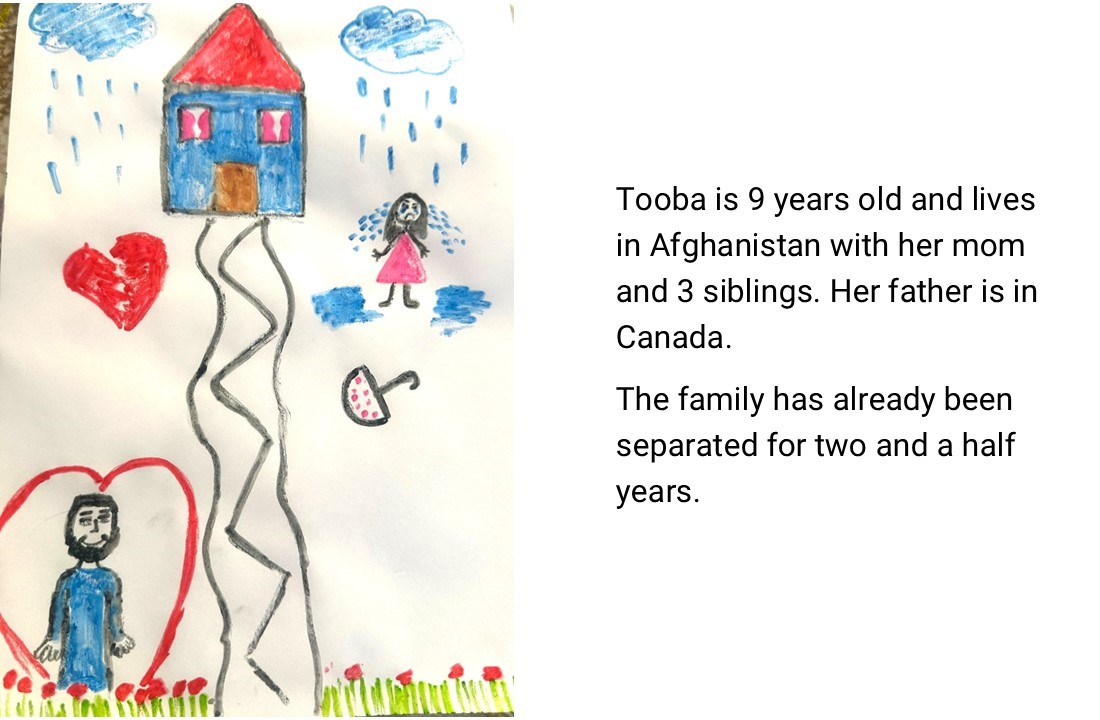
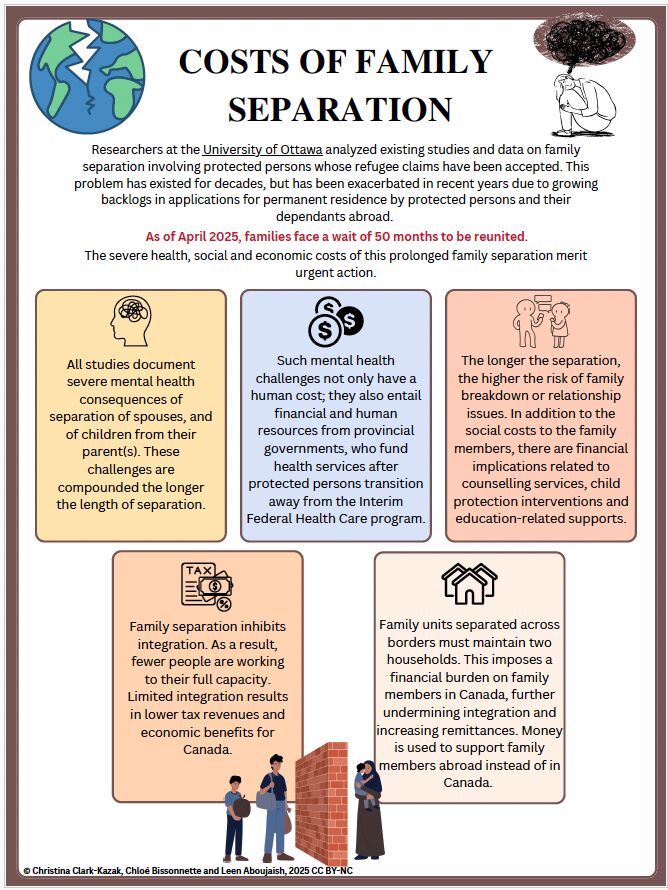
What are the costs of prolonged family separation?
Research undertaken by Christina Clark-Kazak, Professor at University of Ottawa, in collaboration with Chloé Bissonnette, shows the devastating human, social, health and financial costs of family separation for successful refugee claimants, their families and all levels of government. Their report is found here. The key findings are summarized in the infographic below (thanks to Leen Aboujaish for the infographic).
What is the solution?
As a temporary solution, Temporary Resident Permits should be issued to family members overseas, as recommended by the Canadian Bar Association and the Canadian Council for Refugees (see April 2024 letter). In the longer term, a more permanent solution is needed.
What are the financial implications of the proposed solution?
The administrative costs of issuing Temporary Resident Permits to family members would be small.
On the other hand, the measure would lead to significant financial benefits:
- There will be cost savings for the judicial system as families would no longer need to ask the Federal Court to intervene to order faster processing
- Reunited families will be be stronger economically
- Refugees will no longer need to send money overseas to their immediate family
- The costs of delayed reunification on Canada’s health and social systems will be reduced.
Attached files
- Documentrfr-advocacy-faqs.pdf (171.97 KB)